Monthly 2026
250 Years of Jewish Life in America
Monthly Online Events with the Nation’s Top Jewish Historians
$54 gives you access to all live and recorded events
Each event also available as individual purchases, more details below with each event
 Livestream
Join us for a landmark virtual series as we commemorate 250 years of the Jewish experience in America, exploring the profound ways Jewish identity and the American story have shaped one another. Through a series of monthly conversations with the nation’s leading historians, we will journey from the arrival of the first colonial settlers to the vibrant, diverse communities of the modern era.
EXPLORE THE INDIVIDUAL EVENTS IN THE SERIES HERE:

An Ambivalent Welcome: Anti-Judaism in Early America
October 21 at 6 pm ET (and recorded)
$12 plus applicable fees
Get tickets for this event here.
Join us for a presentation by Professor Pamela Nadell as our series celebrating 250 years of Jewish life in America continues. “Gentiles cannot forsake their anti-Jewish prejudice.” In 1791 Rebecca Samuels wrote these words in Virginia. But in other letters she praised America as “the only country in the world for the common man” and admitted that “[a]s for the Gentiles, we have nothing to complain about.” Living in a tiny Jewish community in the new American republic, her words show America’s early Jews holding two truths at the same time. Even as they flourished in the new nation, they understood that their neighbors had not only carried knapsacks across the ocean. They had also carried medieval ideas about nefarious Jews.

How U.S. Citizenship Has Worked – and Not Worked – for Jews
November 19 at 6 pm ET (and recorded)
$12 plus applicable fees
Get tickets for this event here.
A presentation by Professor Lila Corwin Berman as our series celebrating 250 years of Jewish life in America continues. The history of Jews in the United States is often told as if they immigrated, gained citizenship, and almost immediately achieved full legal rights. Yet this story fundamentally misses how citizenship worked for Jews and countless others who have arrived on American shores. Far from a settled point of arrival, citizenship involves a constant process of asking which groups belong and which do not. In this talk, highlighting some of the most significant historical debates about Jewish belonging, Professor Berman shows how the question of Jews’ status persistently linked them to other groups through the mutable yet consequential legal categories of race, nationality, and religion. The history of American Jewish citizenship provides necessary context for understanding today’s struggles over citizenship, rights, and belonging.
AND MORE TO BE ANNOUNCED!
PAST PROGRAMS IN THIS SERIES
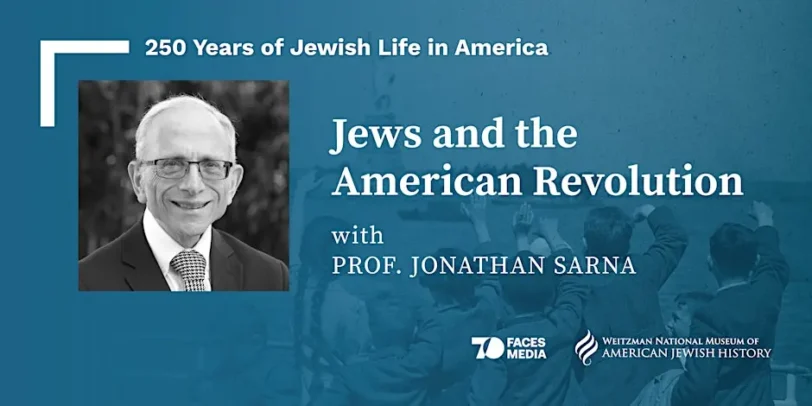
The series begins with Professor Jonathan Sarna, who will cover three essential topics regarding Jews and the American Revolution.
First, Americans looked to the story of biblical Jews to justify independence; this is why Benjamin Franklin and Thomas Jefferson supported a national seal depicting the Exodus from Egypt. Second, Jews contributed to the Revolution in a myriad ways. While their overall numbers were small, many lived in or had taken refuge in Philadelphia, serving as soldiers, merchants, bond dealers, and more. Third, and perhaps most importantly, the Revolution impacted Jews by granting them new rights far beyond mere toleration and transforming American Judaism. The democratization of Judaism and the Jewish community in the United States began in 1776.
We invite you to join us for this lecture with Professor Jonathan Sarna followed by Q&A with New York Jewish Week editor at large Andrew Silow-Carroll.
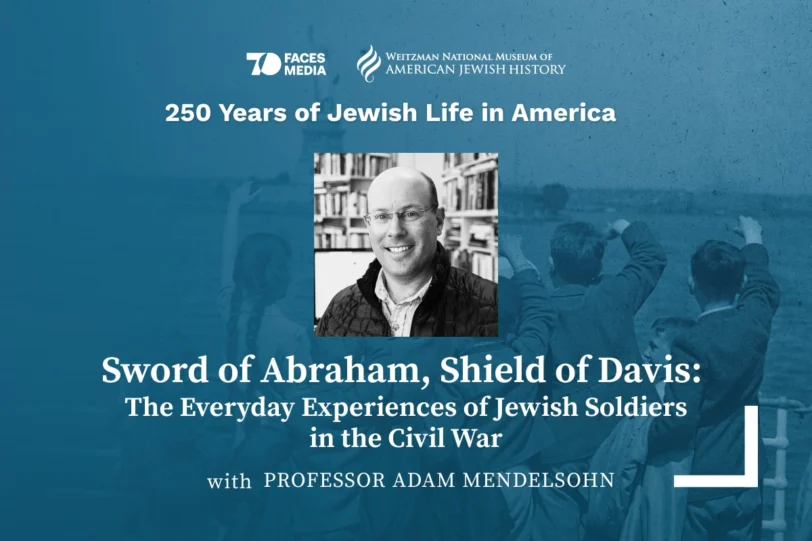
With Professor, Historian and Author Adam Mendelsohn
What was it like to be a Jew in the armies of Abraham Lincoln and Jefferson Davis? Jewish soldiers were religious outsiders in military environments that made few allowances for their specific needs. They were often expected to subsist on diets heavy in pork and to worship on Sundays rather than Saturdays. Furthermore, most of their Christian comrades had never encountered Jewish people before.
This talk will explore the visible and invisible ways that the everyday experiences of Jews were distinct from those of other soldiers who served during the Civil War.
Professor Adam D. Mendelsohn holds the Isidore and Theresa Cohen Chair in Jewish Civilization at the University of Cape Town where he is Director of the Kaplan Centre for Jewish Studies. He is the author of Jewish Soldiers in the Civil War: The Union Army and is at work on a companion volume on the Confederacy.
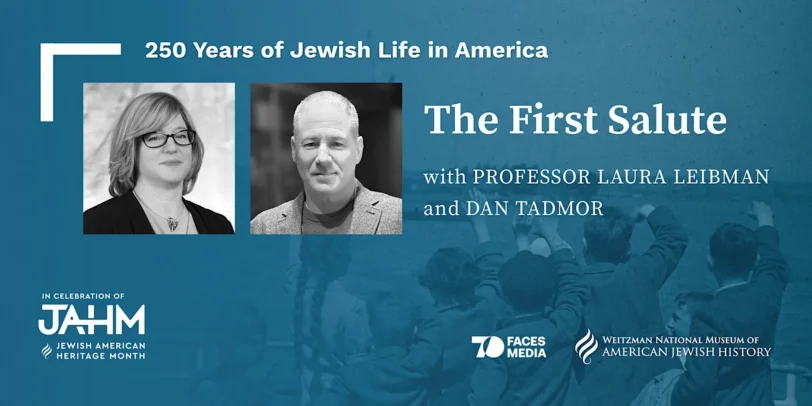
On May 7, during Jewish American Heritage Month, we explore the little-known story of a small group of Jewish merchants in the Caribbean whose outsized contributions to the cause of American liberty helped tip the scales in the fight for independence.
On the lush, windswept island of St. Eustatius, Jewish merchants supplied George Washington’s army with critical contraband and became part of the first international entity to recognize the United States. Their allegiance to the American cause came at great personal cost: targeted by the British, they were stripped of their homes and wealth, torn from their families, driven into exile, and even saw their graves plundered. It is ultimately a story of how these Jews helped win the war—and helped found America.This webinar features Professor Laura Leibman, historian and author, alongside Dan Tadmor, President and CEO of the Weitzman National Museum of American Jewish History. Leibman served as a historical advisor on the Weitzman’s new exhibition, The First Salute, which brings this remarkable and often overlooked story to life for visitors at the museum on historic Independence Mall.
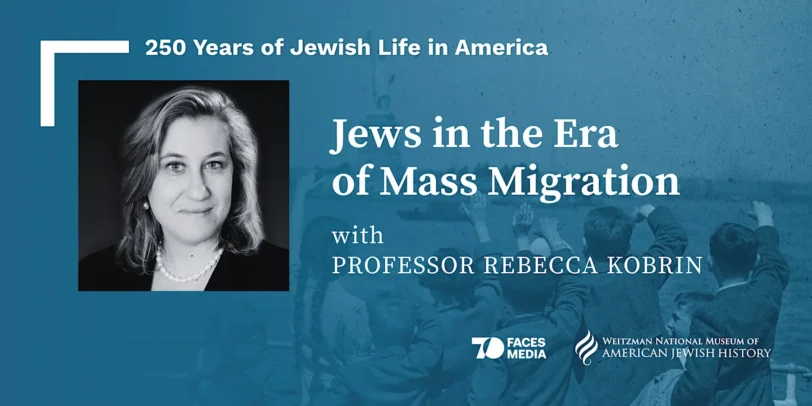
June 7 at 6 pm ET (and recorded)
$12 plus applicable fees
Get tickets for this event here.
Between the late nineteenth and early twentieth centuries, millions of Jews, along with other Europeans, decided to uproot themselves from their places of birth and seek their fortunes in new homes around the world. This decision created new cultural and demographic centers for world Jewry, particularly in the New World, where by 1920, New York City represented the densest urban concentration of Jews anywhere in the world. How did these Jewish migrants reshape America? This lecture will explore these questions as it considers the role migration played in reshaping Jewish life along with American culture, politics and daily life.
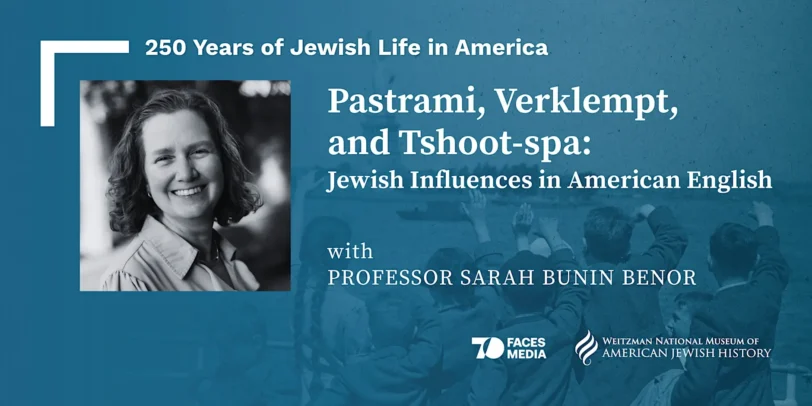
July 15 at 6 pm ET (and recorded)
$12 plus applicable fees
Get tickets for this event here.
Jews in the United States use many Hebrew and Yiddish words in their English conversation. To what extent do non-Jews pick up these linguistic markers? This multimedia talk explains how words like klutz, shpiel, and kibbitz have become part of the broader American lexicon, sometimes popularized by comedians. Politicians use Hebrew and Yiddish words in diverse ways, from Bill Clinton’s “Shalom, chaver” to Michele Bachmann’s mispronunciation of chutzpah. A much more sinister use of Jewish language is white nationalists mocking Jews with words like Goyim and Shoah. Several video clips are shown, from James Cagney as a Yiddish-speaking Irish taxi driver to Barack Obama “getting all verklempt” while honoring Barbra Streisand.
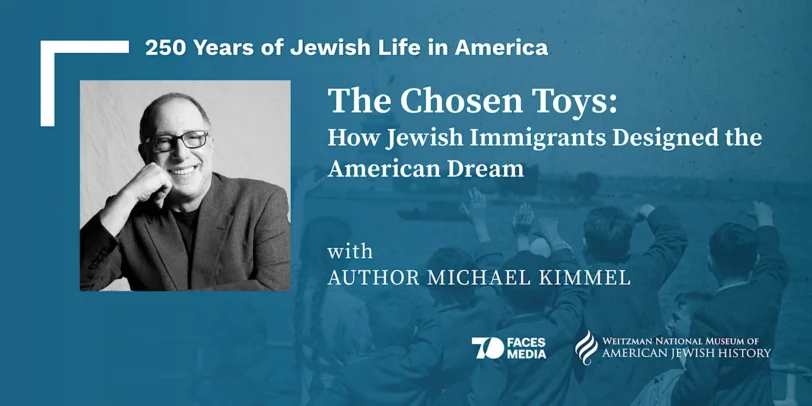
The Chosen Toys: How Jewish Immigrants Designed the American Dream
Author Discussion with Michael Kimmel
August 19 at 6 pm ET (and recorded)
$12 plus applicable fees
Get tickets for this event here.
In his book, PLAYMAKERS: The Jewish Entrepreneurs Who Created the Toy Industry in America, Kimmel documents how first-generation Jewish immigrants—including the founders of Hasbro, Mattel, and Lionel Trains—created the idealized American childhood. From the invention of the Teddy Bear in a Brooklyn candy store to the creation of Barbie and G.I. Joe, Kimmel explores how the experience of being an outsider in 20th-century America shaped the toy industry and childhood as we know it today.
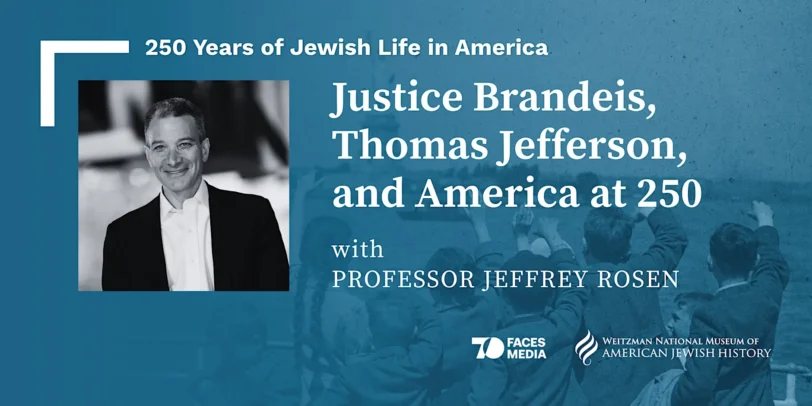
Justice Brandeis, Thomas Jefferson, and America at 250
September 23 at 6 pm ET (and recorded)
$12 plus applicable fees
Get tickets for this event here.
Professor Jeffrey Rosen joins our landmark virtual series to explore the intellectual foundations of Justice Louis Brandeis. As a self-described Jeffersonian, Brandeis famously drew inspiration from Jefferson’s Bill for Religious Freedom when authoring his landmark free speech opinion in Whitney v. California. In this session, Rosen will examine how Brandeis uniquely synthesized Jewish and Jeffersonian traditions within the American context. This discussion offers timely insights into Brandeis’s enduring legacy as we approach the 250th anniversary of the Declaration of Independence.
FREQUENTLY ASKED QUESTIONS
So how does this all work?
- By purchasing our 250 Years of Jewish Life in America series, you are gaining access to a year’s worth of events with the nation’s top Jewish historians. You will be able to watch them all live on Zoom, and they will also be recorded for later viewing. Each event will be one hour long.
Can I purchase a ticket to individual events if I don’t want to buy the full package?
- Yes. (But the entire package for just $54 is quite a deal!)
How many events will there be?
- At least eight, spread out throughout the year.
What if I have more questions about how this works?
- You can email events@70facesmedia.org.